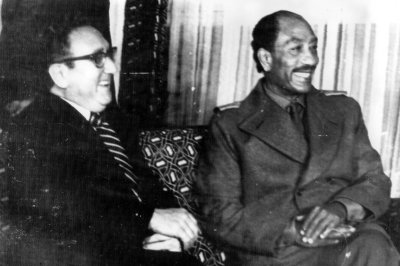
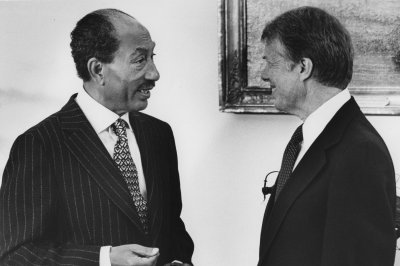
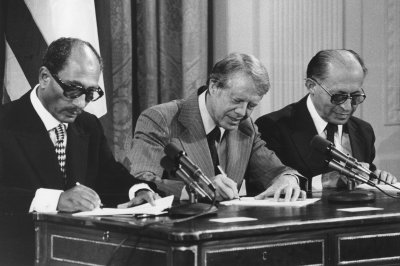




Muhammad Anwar Al Sadat, or Anwar El Sadat (Arabic: محمد أنور السادات‎, Muḥammad Anwar as-Sādāt) (25 December 1918 - 6 October 1981), was the third President of Egypt, serving from 15 October 1970 until his assassination on 6 October 1981. He was a senior member of the Free Officers group that overthrew the Muhammad Ali Dynasty in the Egyptian Revolution of 1952, and a close confidant of Gamal Abdel Nasser, whom he succeeded as President in 1970.

In his eleven years as president he changed Egypt's direction, departing from some of the economic and political principles of Nasserism by reinstituting the multi-party system and launching the Infitah. His leadership in the October War of 1973 and the regaining of Sinai made him an Egyptian hero. His visit to Israel and the eventual Israel-Egypt Peace Treaty won him the Peace Abbey Courage of Conscience award posthumously, but was an act enormously unpopular with the Arab world and Islamists, and resulted in Egypt being expelled from the Arab League.

Anwar El Sadat was born on 25 December 1918 in Mit Abu al-Kum, al-Minufiyah, Egypt to a poor family, one of 13 brothers and sisters. His father was Egyptian, and his mother was Sudanese. He spent his early childhood under the care of his grandmother, who told him stories revolving around resistance to the British occupation and drawing on contemporary history. During Sadat’s childhood, he admired and was influenced greatly by four individuals. The first of his childhood heroes was Zahran, the alleged hero of Denshway, who resisted the British in a farmer protest. According to the story, a British soldier is killed. Zahran was the first Egyptian hanged in retribution for the soldier's death. Stories like the Ballad of Zahran introduced Sadat to Egyptian nationalism, a value he held throughout his life. The second individual was Kemal Ataturk who was leader of the modern Turkey. Sadat admired his ability to overthrow the colonial influence and his many social reforms. He also idolized Mahatma Gandhi and his belief of nonviolence when facing injustice. As Egypt was under the influence and colonialist exploitation of Great Britain, Sadat was fascinated by Hitler’s Nazi German army for their quick ability to become a strategic threat to Egypt's former colonial power. He graduated from the Royal Military Academy in Cairo in 1938 and was appointed in the Signal Corps. He entered the army as a second lieutenant and was posted in Sudan (Egypt and Sudan were one country at the time). There, he met Gamal Abdel Nasser, and along with several other junior officers they formed the secret Free Officers Movement committed to freeing Egypt from British domination and royal corruption.

This article is licensed under the GNU Free Documentation License.
It uses material from the Wikipedia article "Anwar Sadat." | Wiki History
Watercooler Stories
UPI Thoroughbred Racing Roundup
Jockstrip: The world as we know it.
COL BKB: Wash. 88, Cal.St. Northridge 76
Abba, Queen top karaoke picks in Britain
Your Daily Horoscope
The almanac
fark
Train buffs arrested after builoding their own locomotive out of spare parts, garden furniture and...
The six scariest processed foods the world has ever seen, or as they are known in America, 'lunch'...
1,200 limos, 140 private planes and caviar wedges galore. Yep, the Climate Summit
4-hour search with helicopter and bloodhounds caused by a bridesmaid getting so drunk at the reception...
West Dorset police, called to investigate mysterious incidents of horse's manes being plaited, respond...
Today's Instashop Challenge: "Can you photoshop my six-month old on his sled onto some extreme mountains...