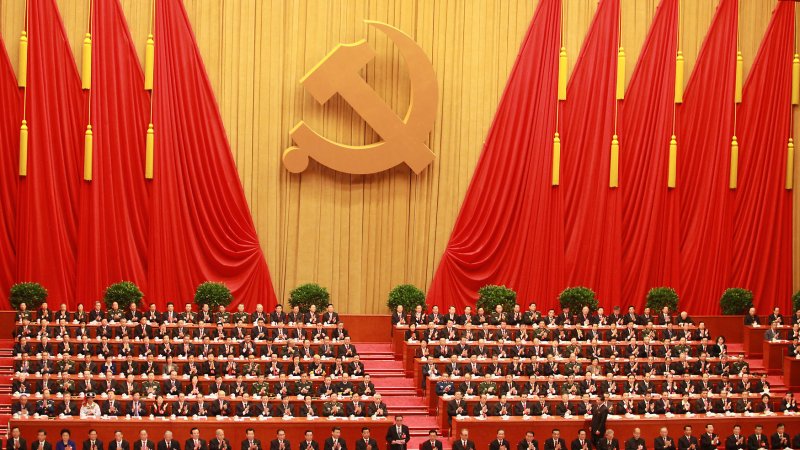
China's top leaders attend the opening ceremony of the18th Communist Party Congress in the Great Hall of the People in Beijing on November 8, 2012. Delegates of the Communist Party have arrived in China's capital for the meeting which begins the once-in-a-decade power transfer. President Hu Jintao will pass the leadership to Xi Jinping. UPI/Stephen Shaver |
License Photo
BEIJING, Nov. 12 (UPI) -- China's Communist Party Congress is picking new leadership that will determine whether liberals or conservatives will be at the country's helm in coming years.
The party, which has ruled China since 1949 under a one-party system, opened its once-in-five-years convention last Thursday amid tight security in Beijing with more than 2,200 delegates attending. This year's congress will also see a once-in-a-decade change in the leadership of the world's second-largest economy.
The delegates began the leadership change process Sunday by considering a list of nominees from which they will pick through secret balloting the party's Central Committee.
The new Central Committee members will then choose the powerful 25-member Politburo and the Politburo Standing Committee, which will be unveiled at the end of the congress this week.
The delegates will also consider whether to reduce the Politburo Standing Committee to seven from the current nine.
"China's leadership transition, which began last year from township level, will surely determine the future of the world's second-largest economy, and influence the world," the official Xinhua News Agency reported Monday.
Xinhua, quoting experts, said a number of current party officials were born in the 1940s, 1950s and 1960s and grew up in a totally different historic and social environment from their predecessors and that will lead to a different administration concept and approach.
"Unlike the founding fathers of the People's Republic of China and previous generations of leading officials who grew up in wartime, the new leadership, mostly born around the founding of New China, grew up in peacetime," the report said.
The officials born after 1950 and with experiences as "educated youth" are an idealistic and realistic group, Xinhua said. The report quoted Cheng Li at the Brookings Institution as saying these leading officials are closely watched by foreigners who are looking into China's future.
Xi Jinping, likely to take over from party General Secretary and Chinese President Hu Jintao at the top of the new leadership, Vice Premier Li Keqiang, an economist expected to succeed Premier Wen Jiabao, will be in the Politburo Standing Committee.
In his keynote speech at the opening of the congress, Hu said alienation from average Chinese citizens poses the greatest risk to the party, and stressed the need for efforts to "put people first, exercise governance for the people and always maintain close ties with them."
Hu also said the party should appoint officials on their merit, select officials on the basis of both their moral integrity and professional competence and promote those who are outstanding in performance and enjoy popular support.
Xie Chuntao, a professor with the Party School of the current Central Committee, said the current crop of leading officials will guarantee the adherence to reform and opening up the path of socialism with Chinese characteristics, Xinhua said.
In his speech, Wen told the delegates that increasing people's income and fighting corruption are the focal tasks to be addressed in the coming years, Xinhua reported.
China is facing a number of challenges, including a slowing economy, widespread official corruption, widening income disparity and growing ethnic tensions, as witnessed by the recent spate of self-immolations by Tibetans protesting Chinese rule of Tibet.
Wen said political structural reform must be advanced simultaneously so as to improve democracy, safeguard social justice and fairness, protect the freedom and equal rights of the people and bring their initiative and creativity into full play.
Xinhua said its survey before the party meeting showed social justice is high on the "wish list" of ordinary Chinese.