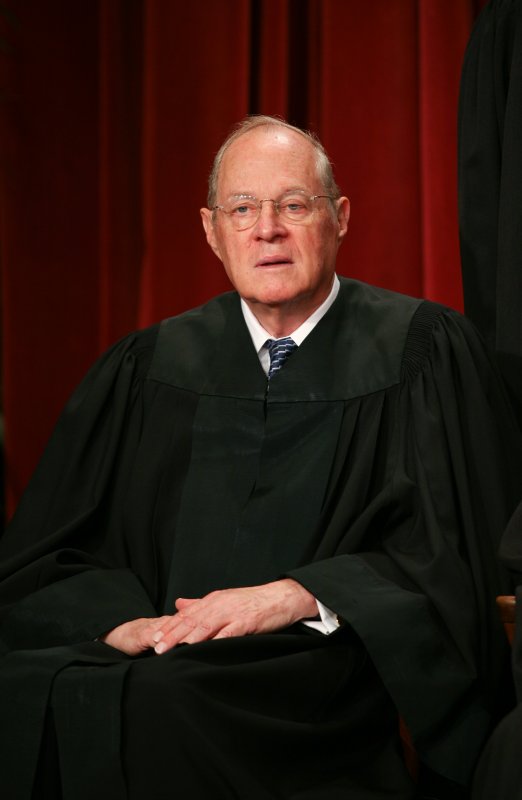
Justice Anthony Kennedy, shown on Sept. 29, 2009. UPI/Gary Fabiano/POOL |
License Photo
WASHINGTON, June 1 (UPI) -- The U.S. Supreme Court ruled 5-4 Tuesday along its ideological divide a suspect must unequivocally claim his right to remain silent in order to have that right.
A dissent said the decision "turns Miranda (vs. Arizona) upside down." Miranda requires police to advise suspects of their right to remain silent and the right to a lawyer. Once those rights are invoked, police must end their questioning until a lawyer is present.
Justice Anthony Kennedy, the high court's key swing vote, joined four conservatives to form the narrow majority.
The case involves Van Chester Thompkins, convicted of shooting Samuel Morris to death outside a mall in Southfield, Mich., in 2000. Another shooting victim survived and later testified.
Thompkins fled, but was arrested a year later in Ohio. Two Southfield officers traveled to Ohio to question him. They advised Thompkins of his Miranda rights, and the suspect remained largely silent for 3 hours. At no point did he invoke his Miranda rights, court records say.
But near the end of the interrogation, the suspect answered "yes" when asked whether he prayed to God to forgive him for the shooting.
Though his lawyers tried to suppress the statement, Thompkins was convicted and sentenced to life. However, a federal appeals court reversed on constitutional review.
The Supreme Court reversed the appeals court.
Kennedy said Thompkins' silence during his interrogation did not invoke his right to remain silent. If a suspect makes an ambiguous or equivocal invocation of that right, police are not required to end their questioning, he said.
Justice Sonia Sotomayor, joined by three other liberals, dissented.
"Today's decision turns Miranda upside down," she said. "Criminal suspects must now unambiguously invoke their right to remain silent -- which, counter-intuitively, requires them to speak. At the same time, suspects will be legally presumed to have waived their rights even if they have given no clear expression of their intent to do so."