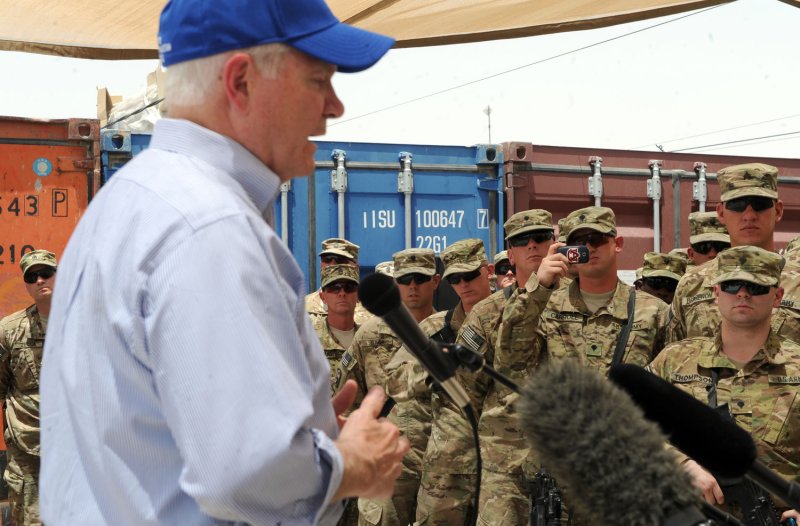
This Department of Defense photo taken on June 5, 2011 shows Defense Secretary Robert M. Gates as he addresses troops at a Forward Operating Base in Afghanistan. UPI/Cherie Cullen/DOD |
License Photo
WASHINGTON, June 13 (UPI) -- Is NATO a paper tiger?
With a "dim, if not dismal future," as outgoing U.S. Defense Secretary Robert Gates put it in a valedictory address before his NATO opposite numbers, NATO is "facing the very real possibility of collective military irrelevance."
The United States and some of its NATO partners are involved in two wars -- Afghanistan and Libya. In Afghanistan, most NATO allies are hobbled by political caveats that prevent them from conducting "kinetic" operations against the Taliban. And two nations that were involved in fighting Taliban guerrillas (Canada and the Netherlands) were told to cease and desist and return home -- by their own Parliaments.
In Libya, most NATO allies decided to sit this one out. And those that joined the air campaign under NATO command against Moammar Gadhafi's command-and-control facilities and his military hardware began running out of bombs and missiles after 11 weeks.
With 20/20 hindsight, the Soviet Union, before it imploded 20 years ago, could have rolled over Western Europe, much the way Hitler did 70 years ago. It was America's tactical and strategic nuclear deterrent that kept the peace for half a century.
Gates warned his European colleagues that the United States, saddled with mounting budget deficits and an increasingly disenchanted public (almost 70 percent for pulling up stakes), couldn't stay the course in Afghanistan without its NATO allies pulling their proper weight.
European allies have gradually scaled down their defense contributions on the assumption the United States would continue to do the heavy lifting. They rushed to America's defense after 9/11 and eagerly agreed to fly troops to Afghanistan to help the United States punish al-Qaida.
Most Europeans figured they would be homeward bound in less than a year. Had they realized this could turn out to be a decade-long commitment, they would have stayed home. Nor did they know that al-Qaida's fighters exited Afghanistan during the battle of Tora Bora in December 2001. None of them volunteered their forces to dump Afghanistan's medieval religious dictatorship and build a democracy in its place.
U.S. defense assistance to the new Afghan army is the same as the entire Afghan government budget, ergo Afghanistan won't be able to fund its own army, which will remain a U.S. burden as far as anyone can see into the future. Unless the U.S. Congress pulls another Vietnam when it cut off any further military assistance to the South Vietnamese army. The denouement is history.
In Libya, the United States encouraged NATO to take command after the first three days as it is already overextended and taking casualties in two theaters -- Afghanistan and Iraq -- and watching apprehensively two additional civil wars in the Middle East: Yemen and Syria.
And in Libya, it wasn't long before a U.N. panel investigating human rights abuses said both sides -- Gadhafi's mercenaries from neighboring sub-Saharan countries and Benghazi's "Mad Max" warriors -- are committing war crimes.
In Syria, 1,400 miles from Tripoli, at the other end of the Mediterranean, President Bashar Assad, whose late father Hafez Assad butchered 20,000 dissidents in Hama in February 1982, is using the same army to kill hundreds of demonstrators (1,400 by last count) in towns and cities throughout the country. Their only demand is the end of 40 years of military dictatorship.
In Jisr al-Shughour, a small northern town near the Turkish border, one 125-strong army unit mutinied -- only to be slaughtered by an elite commando unit led by Assad's brother.
Almost every interlocutor who met with the president in the 10 years since his father died of a heart attack came away with a flattering portrait of a mild-mannered former eye doctor who wasn't a chip off the old block.
Assad has far more blood on his hands than Gadhafi. He is also closely allied with the radical camp, which Gadhafi wasn't. But Syria for the United States is also the third rail in the Arab camp. Damascus is closely allied with the region's anti-U.S. extremists -- Iran, Hamas and Hezbollah. Syria also enjoys a special relationship with two other big world players -- Russia and China.
While the war against Gadhafi's Libya was approved unanimously by the Atlantic alliance, less than one-third of the 28 member nations are carrying out strike missions. Many of the others would like to participate in defeating Gadhafi's dictatorship but their military assets don't stretch much beyond training and parades.
NATO's European allies are in no condition to be spending more on defense. The economic and financial malaise is a Europe-wide condition. The United States is in the same leaky Atlantic boat. Few Americans understand why the United States has to spend more on defense than the rest of the world combined.
They see more pressing needs on the home front. From sewage pipes under major cities and airports to schools and roads, the United States is in urgent need of at least $1 trillion in long-postponed infrastructure projects. To take the United States beyond the must-do-yesterday public works, several additional trillion would be needed to bring the United States up to 21st-century norms (e.g., a bullet train network comparable to China's).
China, meanwhile, is projecting power worldwide -- with 5.8 million workers in a wide variety of civilian development projects (1 million in Africa alone). More than 6,000 Chinese are working with local labor in the Bahamas to erect a $3 billion mini-Las Vegas gambling casino on Cable Beach (a 30-minute flight from Miami).
A dovish Barack Obama didn't even qualify as a dawk -- more dove than hawk -- as he campaigned for the U.S. Senate. Today, President Obama has got the United States involved in four wars: Afghanistan, Iraq (where U.S. troops are still being killed), Libya and Yemen (where the confusion of a civil war gave U.S. drones open skies to target al- Qaida in the Arabian Peninsula.