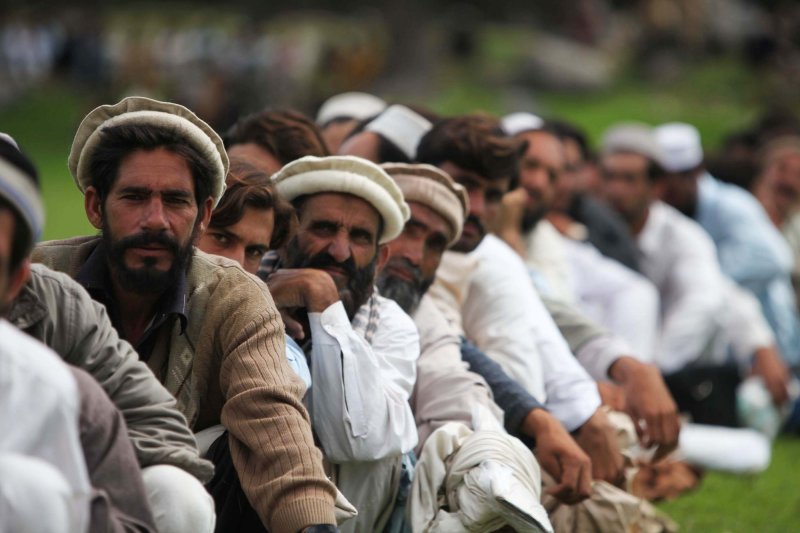
1 of 2 | Pakistani civilians wait to board a CH-53E Super Stallion helicopter during humanitarian relief efforts in the Khyber-Pakhtunkhwa province, Pakistan on August 18, 2010 after massive floods devastated the country. UPI/Paul Duncan/U.S. Military |
License Photo
WASHINGTON, Sept. 3 (UPI) -- The United States spent nine years (1980-89) working closely with Pakistan's military against the Soviet occupation of Afghanistan; followed by 11 years (1990-2001) of punishing Pakistan with all manner of sanctions for its secret nuclear weapons development that it kept denying even existed; followed by nine years (2001-10) making up with Pakistan as "a major non-NATO ally" to enlist its support against al-Qaida and Taliban.
If trust between U.S. and Pakistani military was zero on a 1-to-10 trust-o-meter before 9/11, it painfully and haltingly made it back to 6 or 7 since 9/11. Until last week, that is.
Nine high-ranking Pakistani officers, flying in to attend a yearly meeting at CENTCOM headquarters in Tampa, Fla., found themselves detained at Dulles and then ordered back to Pakistan by Gen. Ashfaq Kayani, the army chief, to protest the way they were treated.
Bone-tired after the long flight from Pakistan via Dubai and London, one of them, not a fluent English speaker, was overheard to say, "Thank Allah, this is my last flight." Next thing they knew, security guards hustled them off the plane. They missed their connecting flight and weren't allowed to call their embassy in Washington or their hosts at CENTCOM in Tampa.
For 10 years in the 1990s, no Pakistani officers came to the United States to attend staff colleges as they had since independence. Many made it to one-, two- and three-star rank without benefit of any U.S. experience. During that period, Pakistan's formidable Inter-Services Intelligence agency gave birth to Taliban with a view to putting an end to the civil war that followed the Soviet exit from Afghanistan. Sept. 11, 2001, and U.S. President George W. Bush's summons to Pakistani President Pervez Musharraf (who had seized power in a military coup in 1999) to join forces against Taliban and al-Qaida, and the Pakistani army was yet again thoroughly confused about friend-or-foe America.
Pakistan is reeling under the most devastating national catastrophe since independence 63 years ago. The monthlong monsoon deluge flooded a densely populated area the size of Florida or England that suddenly became a gigantic lake, destroying one-fifth of the country's irrigation infrastructure, livestock and crops.
A month of floods left countless millions without home, food, water -- and livelihood. Civil administration collapsed under the scale of the disaster.
The army, Pakistan's only solid, disciplined institution, had to move troops battling insurgents and terrorist groups in their Federally Administered Tribal Areas on the Afghan border to flood-relief missions. Helicopters flew over one tiny patch of dry land, a few feet higher than the brown sea around it, to the next, dropping one parcel of canned and cooked food per cluster of huddled survivors. They are without stove or cooking fuel and need clean water and dry milk; temporary shelter; basic medicines to save them from stomach diseases, fever and flu.
A month after disaster struck, many areas in the south remained flooded as monsoon waters cascaded down from the north to empty in the Arabian Sea. A country of 180 million lay discombobulated, 40 percent of them now below Pakistan's poverty line, one of the world's lowest; inflation hit 10 percent and is predicted to reach 15 to 20 percent. Economic growth, estimated to reach 4.5 percent before the disaster, now will probably flatline at zero.
On the brink of total economic collapse, rumors abounded of millions of desperate peasants with nothing more to lose now being organized by extremists to move against the cities. The army's 11 corps commanders debated the advisability of a fifth coup since independence to restore law and order. And the specter of the world's first failed nuclear state, coupled with the nightmare scenario of younger Islamist officers pushing the three stars aside and taking over in the name of Islam, was no longer idle cocktail chatter.
Massive job losses are expected to impact the entire country. Misery breeds violence; the only beneficiaries are extremist groups that back the Taliban insurgency, both in Pakistan and Afghanistan.
Long-banned terrorist organizations like Lashkar-e-Toiba, or Army of the Pure, plunged into flood relief determined to show their army detractors that their aid was the most efficient. LeT was long focused on terrorist operations in Indian-held Kashmir. It also maintains a network beyond Pakistan's borders, similar to Lebanon's Hezbollah.
LeT also relaunched its activities in southeastern and eastern Afghanistan provinces (Kunar, Nooristan, Nangarhar, Laghman, Paktika and Khost). These are provinces where the Afghan Taliban never had a strong following. Due to its Wahabist religious ideology, LeT has revived old links with local Wahabi followers that date to the late 1980s when the head of the movement, Hafiz Saeed, was based in Kunar whence he led the insurgency against the Soviet occupation.
Afghan Taliban are mostly Deobandis and have little influence in the Wahhabi-dominated provinces. LeT has filled the vacuum and declared allegiance to Taliban chief Mullah Omar.
In Pakistan, long-banned jihadi organizations have taken advantage of the current chaos to resurface and organize among the growing numbers of destitute refugees. Pakistan's civilian government doesn't appear to grasp the extent of ground lost to extremist organizations. Army officers are in the forefront of relief efforts -- as are extremist organizations.