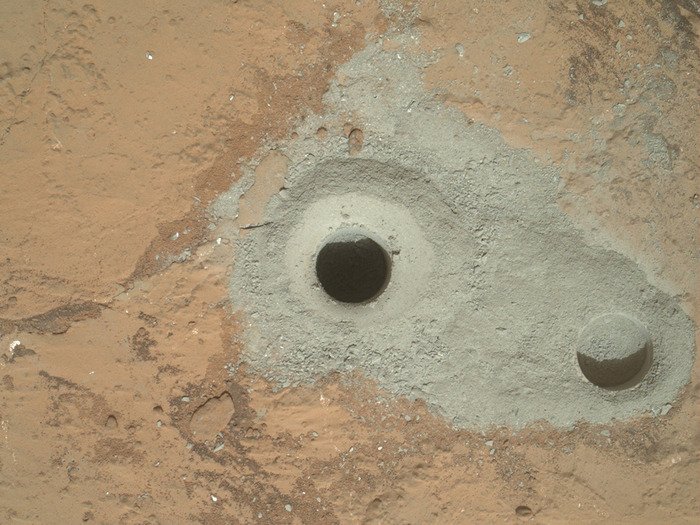
1 of 2 | At the center of this image transmitted to Earth Saturday from NASA's Curiosity rover is the 0.63-inch (1.6-centimeter) diameter and 2.5-inch (6.4-centimeter) deep hole Curiosity drilled for its first sample in a rock called "John Klein." The drilling took place Friday. Several preparatory activities with the drill preceded this operation, including a test that produced the shallower hole to the right. The "mini drill" test hole near it is the same diameter, with a depth of 0.8 inch (2 centimeters). Image credit: NASA/JPL-Caltech/MSSS
PASADENA, Calif., Feb. 9 (UPI) -- NASA said its unmanned Curiosity rover achieved a first this week, using a drill at the end of its robotic arm to bore into a rock on Mars and collect a sample.
Curiosity transmitted photos of its handiwork back to Earth Saturday showing the 0.63-inch (1.6-centimeter) diameter and 2.5-inch (6.4-centimeter) deep hole it made a day earlier in the fine-grained sedimentary bedrock called "John Klein" in memory of a Mars Science Laboratory deputy project manager who died in 2011.
NASA said in a release on its website that the rock is believed to hold evidence about long-ago wet environments. Curiosity will use its laboratory instruments to analyze the rock powder it collected.
"The most advanced planetary robot ever designed is now a fully operating analytical laboratory on Mars," said John Grunsfeld, NASA associate administrator for the agency's Science Mission Directorate. "This is the biggest milestone accomplishment for the Curiosity team since the sky-crane landing last August, another proud day for America."
NASA said ground controllers will spend the next several days commanding the rover's arm to carry out a series of steps to process the sample, ultimately delivering portions to instruments inside.
"We commanded the first full-depth drilling, and we believe we have collected sufficient material from the rock to meet our objectives of hardware cleaning and sample drop-off," said Avi Okon, an engineer at NASA's Jet Propulsion Laboratory in Pasadena, Calif.