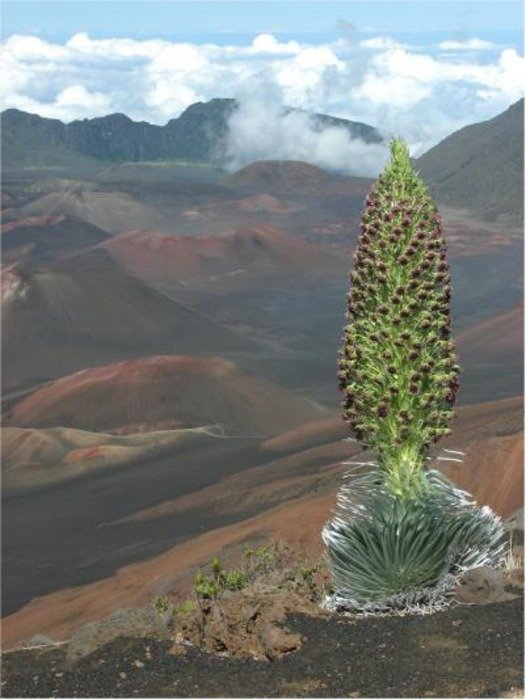
This is a Haleakala silversword in bloom, with Haleakala Volcano crater in background. Credit: Paul Krushelnycky, University of Hawaii at Manoa
HONOLULU, Jan. 16 (UPI) -- The silversword, an iconic Hawaiian plant that recovered from early 20th-century threats, is at risk again, entering a period of climate-related decline.
Scientists said global warming may have severe consequences for the Haleakala silversword plant in its native habitat on the island of Maui.
Known for its striking appearance, the silversword grows for 20 or 90 years before a single reproductive event at the end of its life when it produces a 6-foot tall cluster of flowers with as many as 600 flower heads.
The silversword, Argyroxyphium sandwicense macrocephalum, grows only on the Haleakala volcano summit in Hawaii yet is viewed by 1 million visitors annually at Haleakala National Park.
In jeopardy in the early 1900s due to animals eating the plants and visitors harvesting them, the plant made a comeback as the result of legal protection and conservation efforts but has been in substantial decline since the mid-1990s, researchers said.
Warmer and drier conditions on Haleakala due to climate change could create a bleak outlook for the threatened silverswords that are undergoing increasingly frequent and lethal water stress, they said.
"The silversword is an amazing story of selective biological adaptation of this distant cousin of the daisy to the high winds and sometimes freezing temperatures on the high slopes and thin soils of Haleakala volcano," U.S. Geological Survey Director Marcia McNutt said.
"Despite the successful efforts of the National Park Service to protect this very special plant from local disturbance from humans and introduced species, we now fear that these actions alone may be insufficient to secure this plant's future. No part of our planet is immune from the impacts of climate change."