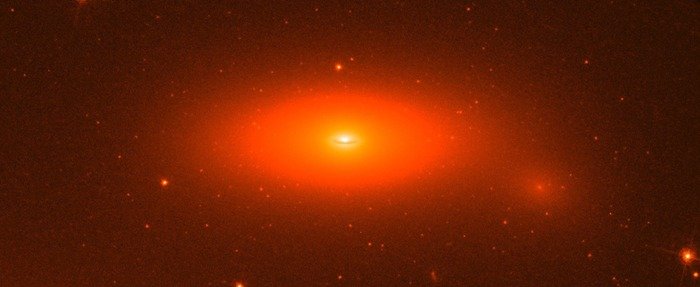
Invisible gravitational trap: the center of the NGC 1277 disk galaxy harbours a black hole with 17 billion solar masses - one of the heaviest ever found. Credit: NASA/ESA/Andrew C. Fabian/Remco C. van den Bosch (MPIA)
HEIDELBERG, Germany, Nov. 29 (UPI) -- European astronomers using a telescope in Texas say they've discovered a black hole that shakes the foundations of current models of galaxy evolution.
Previous studies of the masses of distant galaxies and the black holes at their center have suggested a black hole typically reaches only a tiny fraction -- around 0.1 percent -- of the total mass of all stars belonging to the parent galaxy.
Astronomers from the Max Planck Institute for Astronomy in Heidelberg, Germany, report they've tracked down a black hole that could upset this generally accepted relationship.
Using a telescope at the McDonald Observatory in Texas and images from the Hubble Space Telescope, they determined the black hole at the center of the NGC 1277 disk galaxy weighs 17 billion solar masses.
That means the black hole has around 14 percent of NGC 1277's total mass, significantly more than the 0.1 percent figure considered normal until now.
"This is an oddball," University of California at Berkeley astrophysicist Chung-Pei Ma, who was not part of the research, told the Los Angeles Times. "It's a very big black hole for a small galaxy -- that's the most surprising part."
Astronomer Remco van den Bosch and his Max Planck Institute colleagues say they've also discovered five further galaxies that are comparatively small but may have unusually massive central black holes. If so, they said, astronomers will need to fundamentally rethink their galaxy evolution models.
Their findings have been published in the journal Nature.