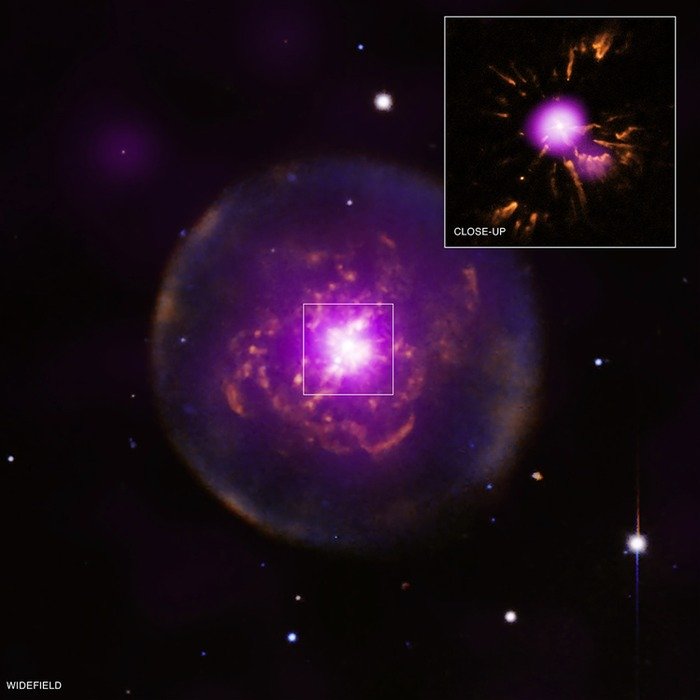
A large spherical shell is seen in emission of hydrogen (blue) and oxygen (red) as the result of the star’s outer shell being stripped off by a dense wind and expanding outward over the last 12,500 years. During the ‘born-again’ phase in the star’s evolution, it expelled knots of helium and carbon-rich material. Credit: Main image: X-ray: ESA/XMM-Newton; optical: NSF/NOAO/KPNO; inset: NASA/CXC/IAA-CSIC/M. Guerrero et al; optical: NASA/STScI
PARIS, Nov. 15 (UPI) -- Astronomers say evidence of a dying sun-like star coming briefly back to life after throwing off its gassy shells shows the possible fate our own solar system.
The "born-again" star, Abell 30, was captured in a composite of visible images from NASA's Hubble Space Telescope and X-ray data from the European Space Agency's XMM-Newton and NASA's Chandra space telescopes, a release from the Paris headquarters of the ESA said Thursday.
Astronomers know stars like our sun swell into red giants toward the end of their lives, throwing off their outer layers of gasses.
Abell 30 experienced its first brush with death 12,500 years ago, as seen from Earth, when its outer shell was stripped off by a slow and dense stellar wind, astronomers said.
Then about 850 years ago the star suddenly came back to life, throwing out knots of helium and carbon-rich material in a violent event, they said.
The star's outer envelope briefly expanded during this born-again episode, then rapidly contracted.
The violent history of Abell 30 provides a chilling look at the possible fate of Earth and its fellow planets in our own solar system in a few billion years' time, the researchers said.
When the sun emits its final gasps of life, the strong stellar wind and harsh radiation of the death throes will blast and evaporate any planets that may have survived the red giant phase of stellar evolution, they said.