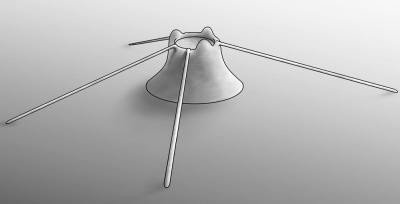
This is a reconstruction of how Coronacollina would have appeared in life. It remained in place on the sea floor, and may have used its spicules as support struts. Coronacollina resembles the Cambrian fossil sponge, Choia. The three raised points on the rim are evident, with a central hollow and four spicules extending from the cone rim. Credit: Daniel Garson for Droser lab, UC Riverside
RIVERSIDE, Calif., March 9 (UPI) -- Paleontologists say they've discovered fossils of the oldest animal with a skeleton, between 560 million and 550 years old, in South Australia.
The age of Coronacollina acula places it in a time known as the Ediacaran Period, named after the Ediacara Hills of South Australia, ranging from 630-542 million years ago, before the explosion of life and diversification of organisms that took place on Earth in the following Cambrian period from 542 million to 488 million years ago, they said.
"Up until the Cambrian, it was understood that animals were soft bodied and had no hard parts," Mary Droser, a geology professor at the University of California, Riverside, who led the team making the discovery, said.
"But we now have an organism with individual skeletal body parts that appears before the Cambrian. It is therefore the oldest animal with hard parts, and it has a number of them -- they would have been structural supports -- essentially holding it up. This is a major innovation for animals."
Apart from its hard parts, it is constructed in the same way that Cambrian sponges were constructed, she said in a university release Friday.
"It therefore provides a link between the two time intervals," Droser said. "We're calling it the 'harbinger of Cambrian constructional morphology,' which is to say it's a precursor of organisms seen in the Cambrian. This is tremendously exciting because it is the first appearance of one of the major novelties of animal evolution."
The finding suggest the initiation of skeletons was not as sudden in the Cambrian as was thought, and that older Ediacaran animals are part of the evolutionary lineage of animals as we know them today, she said.