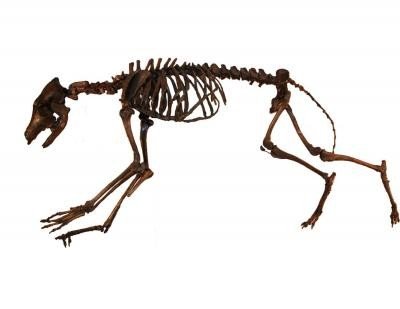
Skeleton of an Ice Age Coyote (Canis latrans orcutti) from the Rancho La Brea Tar Pits in Los Angeles. This skeleton is a composite from the University of California Museum of Paleontology. Credit: F. Robin O'Keefe.
DURHAM, N.C., Feb. 28 (UPI) -- Modern-day coyotes are pint-sized compared to their Ice Age ancestors and probably shrank due to dwindling food supplies, U.S. researchers said.
The sudden shrinkage between 11,500 and 10,000 years ago -- almost instantaneously in geologic terms -- was most likely a response to a decrease in food supplies and changing interactions with competitors rather than the warming climate after the Ice Age, researchers say.
Researchers at the National Evolutionary Synthesis Center in Durham, North Carolina said a study of museum collections of coyote skeletons dating from 38,000 years ago to the present day shows that at the end of a period called the Pleistocene, coyotes in North America suddenly got smaller.
"Pleistocene coyotes probably weighed between 15-25 kilograms (33 to 55 pounds), and overlapped in size with wolves. But today the upper limit of a coyote is only around 10-18 kilograms (22 to 39 pounds)," study co-author Julie Meachen said in a release from the center Monday.
"Within just over a thousand years, they evolved into the smaller coyotes that we have today," she said.
Before the sudden shrinkage in coyotes, many large mammals in North America that had been prey for coyotes -- horses, sloths, bison and others -- were killed off in a wave of extinctions, the researchers said.
While coyotes survived the extinctions, there were fewer large prey left for them to eat.
Since smaller individuals require less food to survive or could switch to smaller prey, smaller coyotes would have had an advantage, the researchers said.