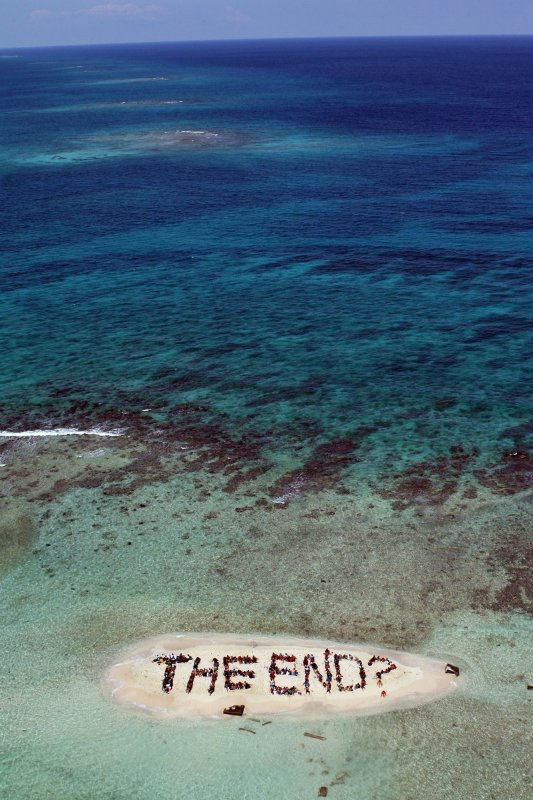
Hundreds of international supporters gather to form a human banner asking if the end is near for the Belize and other endangered coral reefs around the world, on an island on the Belizian Barrier Reef off the coast of Belize City, Belize, on November 13, 2010. The action was on the final day of the three-day Belize Reef Summit which urged global leaders to take strong action at the upcoming U.N Climate Talks in Cancun, Mexico. UPI/Lou Dematteis/Spectral Q |
License Photo
CANBERRA, Australia, Feb. 22 (UPI) -- Australian scientists say corals reefs in the South China Sea, West Pacific and Coral Triangle are key to preserving fish and marine resources in the region.
Research by Johnathan Kool of the Australian Research Council's Center of Excellence for Coral Reef Studies and colleagues has established that the richest marine region on Earth -- the so-called Coral Triangle between Indonesia, Malaysia and the Philippines -- depends for its diversity and resilience on coral and fish larvae swept in from the South China Sea and Solomon Islands, an ARC release said Tuesday.
"The currents go in various directions, but the prevailing direction is from east to west, and this carries coral spawn and fish larvae from areas such as round the Spratly Islands in the South China Sea and the Solomons/Papua New Guinea," Kool said.
"Maintaining the network of links between reefs allowing larvae to flow between them and re-stock depleted areas is key to saving coral ecosystems threatened by human pressure and climate change," he said.
Recent evidence suggesting the region's marine biology is closely interconnected shows it is in the interests of all Asia-Pacific countries to work together more closely to protect it, he said.
"These coral ecosystems provide food and income for more than 100 million people working in marine-based industries throughout the region," Kool said.
"Even though coral reef communities may not be connected directly to one another, reefs on the edge of the Coral Triangle have the potential to contribute significant amounts of genetic diversity throughout the region."
Six nations within the Coral Triangle -- Indonesia, the Philippines, Malaysia, Papua New Guinea, The Solomon Islands and Timor-Leste -- are now working together to strengthen coral reef governance and management, the ARC release said.